
























Send a message
We’re here to answer any question you may have.
career
Would you like to join our growing team?
career@cranai.com
We’re here to answer any question you may have.
Would you like to join our growing team?
career@cranai.com
One of the most important phases in UX design is actually done before the product team creates anything. Before you can build a product, you need to understand its context for existence. The product definition phase sets the foundation for the final product. During this phase, UX designers brainstorm around the product at the highest level (basically, the concept of the product) with stakeholders.
interviewing key stakeholders to gather insights about business goals.
thinking about the key aspects and value propositions of the product: what it is, who will use it, and why they will use it. Value propositions help the team and stakeholders create consensus around what the product will be and how to match user and business needs.
creating an early mockup of the future product (can be low-fidelity paper sketches of the product’s architecture).
This phase typically ends up with a project kick-off meeting. The kick-off meeting brings all the key players together to set proper expectations both for the product team and stakeholders. It covers the high-level outline of the product purpose, team structure (who will design and develop the product), communication channels (how they will work together), and what stakeholders’ expectations are (such as KPIs and how to measure the success of the product).
Once you’ve defined your idea, the product team moves to the research phase. This phase typically includes both user research and market research. Seasoned product designers think of research as a good investment—good research informs design decisions and investing in research early in the process can save a lot of time and money down the road.
The product research phase is probably the most variable between projects—it depends on the complexity of the product, timing, available resources, and many other factors.
This phase can include:
A great product experience starts with a good understanding of the users. In-depth interviews provide qualitative data about the target audience, such as their needs, wants, fears, motivations, and behavior.
Research helps UX designers understand industry standards and identify opportunities for the product within its particular niche.
The aim of the analysis phase is to draw insights from data collected during the research phase, moving from “what” users want/think/need to “why” they want/think/need it. During this phase, designers confirm that the team’s most important assumptions are correct.
This phase of the UX process usually includes:
Personas are fictional characters that represent the different user types for your product. As you design your product, you can reference these personas as realistic representations of your target audience.
A user story is a tool that helps designers understand the product/service interactions from the user’s point of view. It’s usually defined with the following structure: “As a [user] I want to [goal to achieve] so that [motivation].”
Storyboarding is a tool that helps designers connect user personas and user stories. As the name suggests, it’s essentially a story about a user interacting with your product.
When users’ wants, needs, and expectations from a product are clear, product designers move to the design phase. At this step, product teams work on various activities, from creating information architecture (IA) to the actual UI design. An effective design phase is both highly collaborative (it requires active participation from all team players involved in product design) and iterative (meaning that it cycles back upon itself to validate ideas).
The design phase usually includes:
Sketching is the easiest and fastest way to visualize our ideas. You can do this by drawing by hand on a piece of paper, on a whiteboard, or in a digital tool. It’s very useful during brainstorming sessions because it can help the team visualize a broad range of design solutions before deciding which one to go with.
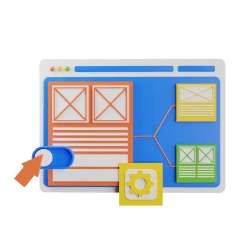
A wireframe is a tool that helps designers visualize the basic structure of a future page, including the key elements and how they fit together. Wireframing acts as the backbone of the product, and designers often use them as a foundation for mockups and prototypes.
Sketching is the easiest and fastest way to visualize our ideas. You can do this by drawing by hand on a piece of paper, on a whiteboard, or in a digital tool. It’s very useful during brainstorming sessions because it can help the team visualize a broad range of design solutions before deciding which one to go with.
Validation is an essential step in the design process because it helps teams understand whether their design works for their users. Usually, the validation phase starts after the high-fidelity design is ready, since testing with high-fidelity designs provides more valuable feedback from end-users). During a series of user testing sessions, the team validates the product with both stakeholders and end-users.
The validation phase of the UX process may include the following activities:
Once the design team has iterated the product to the point where it’s usable, it’s time to test the product in-house. Team members should try using the product on a regular basis, completing routine operations to uncover any major usability flaws.
User testing sessions with people who represent your target audience are very important. There are many different formats to try, including moderated/unmoderated usability testing, focus groups, beta testing, and A/B testing.
Surveys are a great tool for capturing both quantitative and qualitative information from real-world users. UX designers can add open-ended questions like “What part of the product you dislike?” to get user opinions on specific features.
Validation is an essential step in the design process because it helps teams understand whether their design works for their users. Usually, the validation phase starts after the high-fidelity design is ready, since testing with high-fidelity designs provides more valuable feedback from end-users). During a series of user testing sessions, the team validates the product with both stakeholders and end-users.
The validation phase of the UX process may include the following activities:
This is a limited release of your product to a small amount of people with the goal of finding issues and cleaning them up before you launch it to the world.
Once your product launches, it’s time for another round of analysis.
Instead of looking at the results of your research, though, you’ll be taking a look at your overall final product.
Some questions you might ask yourself:
By thoroughly analyzing the product and the UX process, you’ll be able to get more out of the experience than just a product—you also gain invaluable knowledge you can leverage for the future.
For creating amazing UX/UI interfaces, one requires to follow a systematic and organized approach. A UI/UX design process strategy will help you in achieving the same.
The entire design team will be playing their part in the process. This is one of the best ways to retain your existing customers and attract new ones in this highly competitive world.
Well, contact us for a leading UI/UX design agency to work on your next project. It is bound to be an amazing experience.
Passionate about solving problems through creative communications.
01
02
03


Bring your ideas to life with an intuitive visuals editor. Create, edit, and customize your website visually and see the changes instantly.
I am really impressed by the quality of services I received from Cranai. You were right on schedule, charged reasonable prices, were professional and courteous in dealings, and delivered items well before time. I have got a good e-commerce site for my products. My revenue has increased because of Cranai and I will definitely use your services again.


I wanted to take a moment to thank you for the services your team has provided. Your team has been a pleasure to work with, professional and timely. The only delay in work that we have experienced has been due to our own lack of organization managing our projects, not yours. Job well done and I hope we can continue to grow together.


We have worked with Cranai on various projects, and find that they provide quality service and expertise for our programming needs. It is rare to find a service provider with such professional consistency - they are a valued service provider to our business!



Digital experiences, and print materials that communicate marketing goals.
Project Offers
Consultation
Adding {{itemName}} to cart
Added {{itemName}} to cart